Boosting Intelligence Density of AI Factories
To adapt to the challenges of increasing power demand, AI factories need to reimagine how they get energy from power plants.
In a previous blog on data centers, we described a transition in data center design to 800-volt architecture.[1] In this blog, we’ll break down the 800-volt concept, explain why data center architects are making that switch, and show how QS technology can help address the challenges this new design presents.
Why does voltage matter?
First, the basics. 800-volt describes the nominal operating voltage of the system. Voltage (V) is one of the two fundamental measures of electric systems; the other is current, measured in amperes (for short, amps or simply A). Amps describes the number of fundamental units of charge (corresponding to electrons, lithium ions, or other charge carrier) moving through a system per second. Voltage describes how much energy each unit of charge carries.[2] Current multiplied by voltage gives you the nominal power of a system, in watts: Volts x Amps = Watts.[3]
So, to increase the power of a system, either the voltage or the current must be increased. Increasing the current, however, presents a challenge: it requires thicker wires and wastes more energy as heat, increasing the cost of the system and reducing its efficiency.
At today’s standard of 48V or 54V, a single next-generation 1-megawatt (MW) rack might require as much as 450 lbs. of copper wiring. That’s costly as well as physically impractical. Moving to 800V architecture can address this impracticality by reducing the amount of copper wiring necessary and can also reduce heat losses significantly. NVIDIA projects 45% less copper and 5% better end-to-end efficiency as a result of the shift to 800V architecture. But the transition to 800V is more than just a nice-to-have improvement to operational efficiency; it is essentially a physical requirement to enable much higher rack power and hence better-performing AI models.
Fortunately, the challenge that data center architects are facing is one that the electric vehicle industry already solved. Modern electric vehicles were first designed around a 400V architecture, but to achieve better system performance, especially faster charging, many advanced EVs have doubled that to 800V. Raising system voltage isn’t a free lunch: increasing the system voltage raises the risk of electrical arcing (current jumping across gaps), requiring a more sophisticated design to maintain safe operation. However, automakers have overcome these engineering challenges, and the components and systems are well-proven in real-world conditions.
With the push for higher performance in AI data centers, data center architects are now adopting much of the same technology developed by the EV industry, and since 800V is the standard for top-of-the-line EVs, NVIDIA and others have planned for the AI data centers of the future to run on 800V systems as well. However, this is not a trivial challenge. If the entire AI data center is operating at 800V, individual components must also be 800V capable. Moreover, having relatively high voltages running deep into the heart of the data center raises the stakes for safety.
QS in the 800V era
QS cells are the right technology at the right time to enable this high-power 800V era of AI data center design. QS cells have already been demonstrated powering 800V architecture: the Ducati V21L race bike shown at IAA Mobility in Munich features an 800V drivetrain. QS cells are designed from the ground up to meet high-performance automotive specifications in a space-constrained pack, making them a natural fit in the AI data center operating environment.
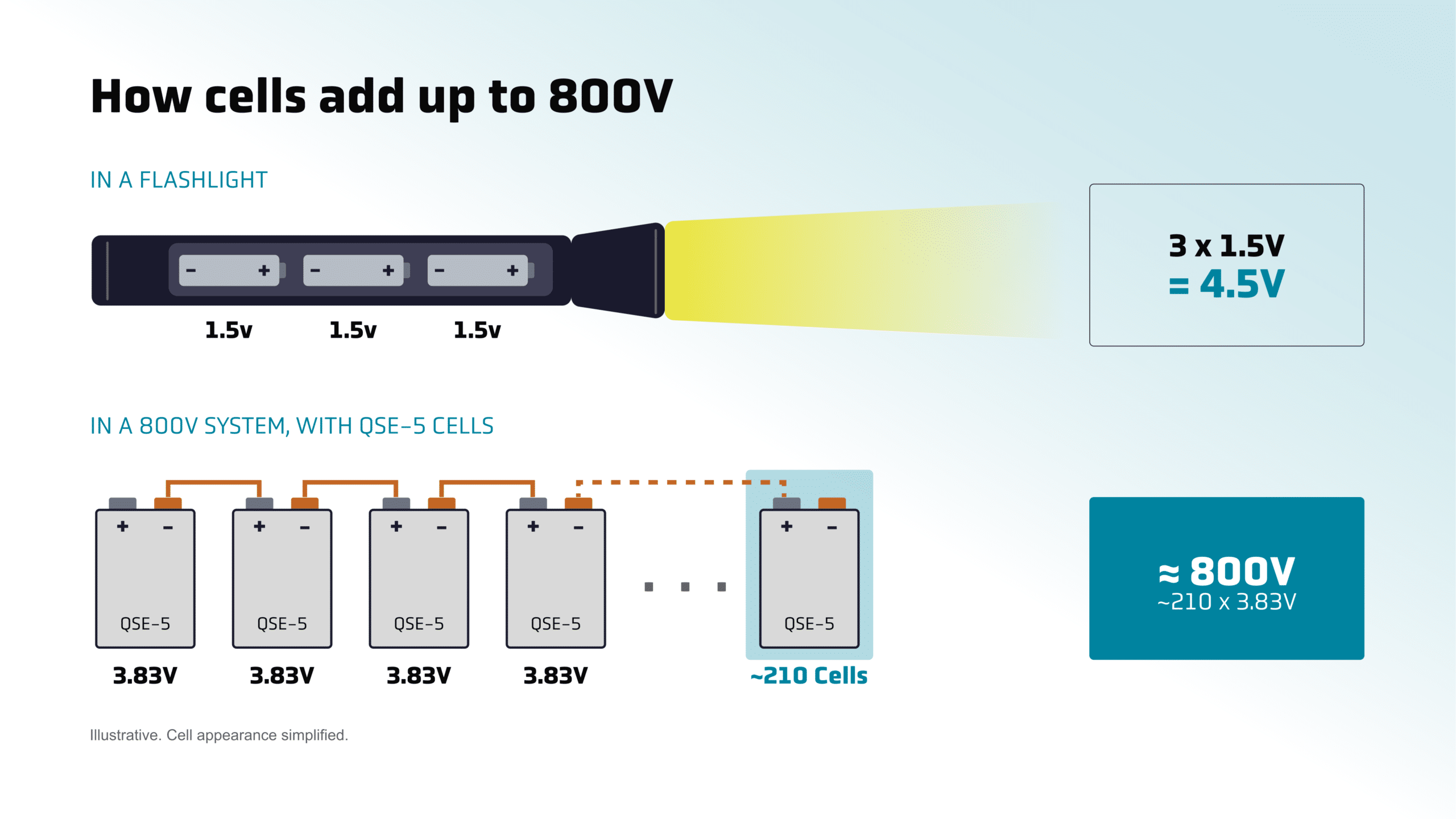
Series connections
To reach a system-level voltage of 800V, individual cells must be wired in series, with the negative terminal of one cell wired to the positive terminal of the next cell, like batteries in a flashlight. Lithium-ion battery cells operate at a nominal voltage of between ~3.2V (LFP) and ~3.7V (NMC), and QSE-5 battery cells operate at ~3.83V. So reaching 800V takes ~210 individual cells wired together in series, or ~250 if LFP cells are used. This is the minimum number of cells that an 800V-native system must contain; since the cell must fit in a fixed space, it also limits how big each cell can be.

Any thermal runaway can knock billion-dollar assets offline and permanently destroy customer data. What’s more, at 1 MW of power at the rack level, data centers may operate at much higher temperatures than a typical EV battery pack. In abuse testing, QS technology has demonstrated , including thermal stability well above 300 °C, versus ~180 °C for a conventional reference cell in our testing, offering AI data center operators more design flexibility and greater peace of mind. This benefit comes in addition to the higher energy density and improved power performance capability of QS battery technology.
Conclusion
The transition of data centers to 800V architecture mirrors the technology transition made by the EV industry, and components for EV drivetrains are being adapted for use in the AI data center. QS technology has been built to enable next-generation EV performance, and we believe the benefits of our technology are a natural fit for the coming wave of 800V AI data center designs.
[1] The transition also involves moving from alternating current to direct current. A comparison of alternating and direct current systems is outside the scope of this blog.
[2] For more on the role of voltage in battery storage systems, read our blog on the difference between capacity and energy.
[3] This is true for direct current systems. Alternating current systems require a more complex calculation.
Forward-Looking Statements
This publication contains forward-looking statements within the meaning of the federal securities laws . All statements other than statements of historical fact contained in this publication, including statements regarding the future development of QuantumScape’s battery technology, the anticipated benefits and use cases of QuantumScape’s technologies, the performance and safety of its batteries and demonstration in real-world applications, plans and objectives for future operations, partnerships, commercialization and markets, and expected global demand for batteries and the value thereof, are forward-looking statements. When used in this publication, the words “aim,” “anticipate,” “believe,” “blueprint,” “can,” “committed,” “continue,” “could,” “designed to,” “estimate,” “expect,” “future,” “going forward,” “intend,” “may,” “move,” “must,” “offers,” “plan,” “potential,” “predict,” “pro forma,” “project,” “roadmap,” “should,” “tend,” “target,” “will,” “would,” and the negative of such terms and other similar expressions are intended to identify forward-looking statements, although not all forward-looking statements contain such identifying words.
These forward-looking statements are based on management’s current expectations, assumptions, hopes, beliefs, intentions, and strategies regarding future events and are based on currently available information as to the outcome and timing of future events. These forward-looking statements involve significant risks and uncertainties that could cause the actual results to differ materially from the expected results. Many of these factors are outside QuantumScape’s control and are difficult to predict. QuantumScape cautions readers and viewers not to place undue reliance upon any forward-looking statements, which speak only as of the date made. Except as otherwise required by applicable law, QuantumScape disclaims any duty to update any forward-looking statements. Should underlying assumptions prove incorrect, actual results and projections could differ materially from those expressed in any forward-looking statements. Additional information concerning these and other factors that could materially affect QuantumScape’s actual results can be found in QuantumScape’s periodic filings with the SEC. QuantumScape’s SEC filings are available publicly on the SEC’s website at www.sec.gov.

To adapt to the challenges of increasing power demand, AI factories need to reimagine how they get energy from power plants.

AI data centers are fundamentally different from the cloud data centers of the previous decade. Data centers of the past delivered data; modern AI data centers deliver intelligence.

AI racks are headed to 1 MW, and 48V power can’t keep up. Here’s why data centers are moving to 800V and how solid-state batteries fit the shift.

To adapt to the challenges of increasing power demand, AI factories need to reimagine how they get energy from power plants.
Privacy Policy | Terms of Use
© 2026 QuantumScape Battery, Inc.
1730 Technology Drive, San Jose, CA 95110
info@quantumscape.com
Pamela Fong is QuantumScape’s Chief of Human Resources Operations, leading people strategy and operations, including talent acquisition, organizational development and employee engagement. Prior to joining the company, Ms. Fong served as the Vice President of Global Human Resources at PDF Solutions (NASDAQ: PDFS), a semiconductor SAAS company. Before that, she served in several HR leadership roles at Foxconn Interconnect Technology, Inc., a multinational electronics manufacturer, and NUMMI, an automotive manufacturing joint venture between Toyota and General Motors. Ms. Fong holds a B.S. in Business Administration from U.C. Berkeley and a M.S. in Management from Stanford Graduate School of Business.