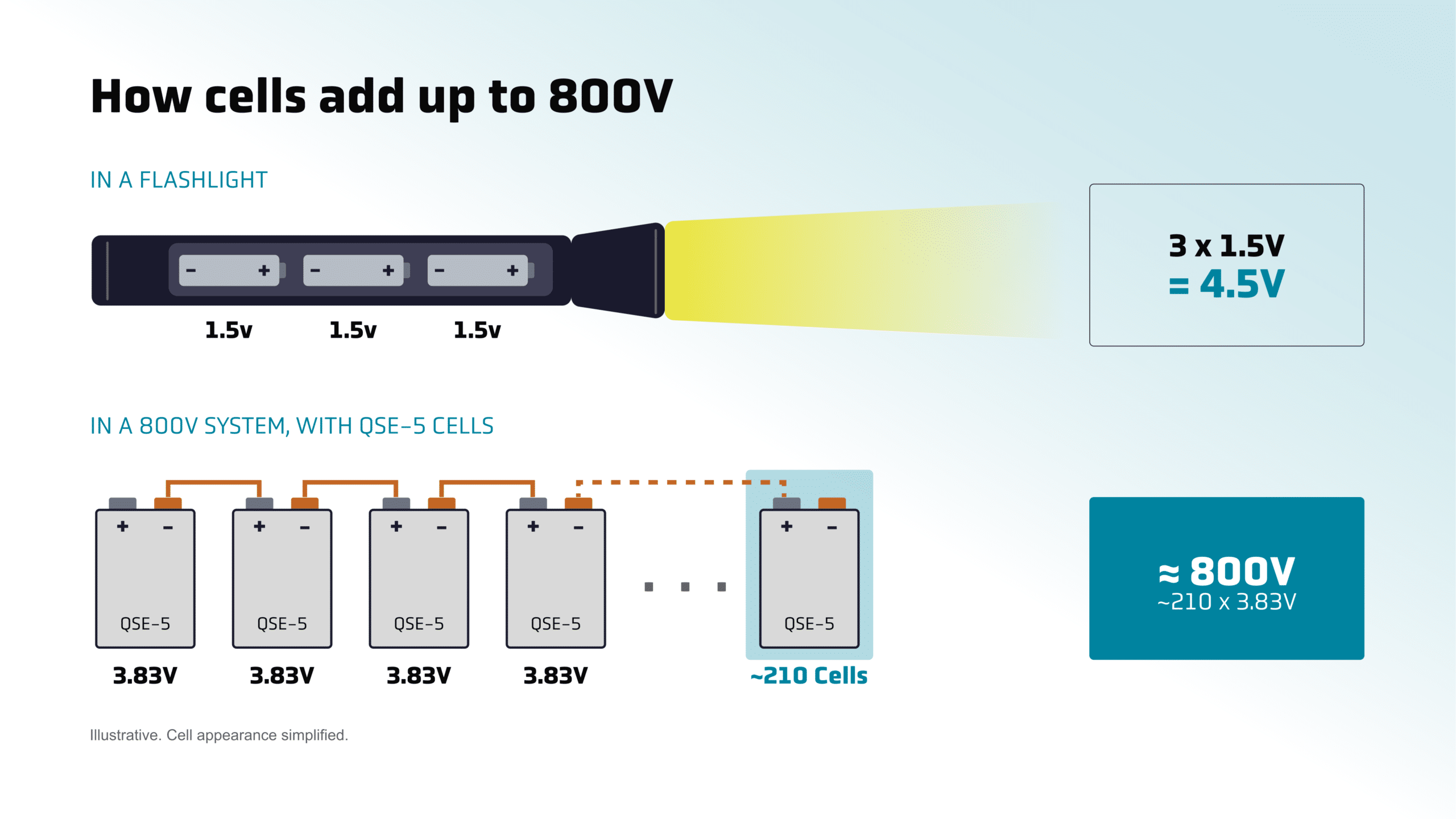
800-volt architecture for data centers: why AI is raising the voltage
AI racks are headed to 1 MW, and 48V power can’t keep up. Here’s why data centers are moving to 800V and how solid-state batteries fit the shift.

In Part 1, we looked at earlier data center designs and how the massive increase in power demand from AI factories requires a reimagining of the energy flow. In this second part, we will see the ways QS solid-state lithium-metal battery technology, with its higher energy density, high power, and improved safety, can help to boost the intelligence density of the AI factories of the future.
Deliver, Store, Use: The AI Power Pipeline
To adapt to the challenges of increasing power demand, AI factories need to reimagine how they get energy from power plants. In this new model, the energy must be delivered into the AI factory in a usable form, stored, and then used to boost AI workloads. QS technology has the potential to improve all three parts of the energy flow, enabling more efficient and more powerful AI.
As power demand for AI factories skyrockets, the need for efficiency is growing. For a 1-gigawatt data center, even 1% losses would represent enough power to supply thousands of homes. To achieve better performance, AI factories are borrowing technology from electric vehicles and moving to 800V direct current (DC) architectures.
High-voltage DC allows more efficient systems that use less copper and generate less heat. Power transmission at 800V DC also allows an AI factory to eliminate equipment that would otherwise be necessary to convert direct current to alternating current and back. In fact, DC systems are at their most efficient when they interact with DC-native components. Batteries fundamentally already charge and discharge with DC power natively, which allows the energy flow into the data center to eliminate wasteful intermediate steps.
However, high-voltage designs amplify the existing safety challenges of AI factories. Safety is particularly important for batteries deployed in the power rack. Unlike long-duration backup power, which is located far away from the valuable compute racks, short-duration battery power is as close to the compute rack as possible to keep wires short, improve efficiency and maintain responsiveness. But with each compute rack containing millions of dollars’ worth of chips, a fire or explosion in a lithium-ion battery puts those valuable chips in harm’s way, and the disruptions to system uptime can be expensive.
This presents an opportunity for QS battery technology with its proprietary non-combustible ceramic separator. QS batteries have been shown to be thermally stable up to 300 °C; in our testing, we observed that the reference conventional lithium-ion battery went into thermal runaway at ~184 °C. Because of the safer solid-state design of QS batteries, AI factories could achieve higher intelligence density without increased safety risks.
The heart of the AI factory is the compute racks. These chips actually generate the intelligence that AI companies sell to their customers. Everything else in the AI factory is an extra cost, so there is a clear economic imperative to maximize the amount of compute in an AI factory and minimize everything that isn’t directly earning money.
This means there is a straightforward requirement to make AI data centers as compact as possible. Efficient design minimizes the length of every wire, cable and pipe that connect the chips, cooling, and power systems together. Because AI factories can cost tens of billions of dollars, the potential cost savings in this area are substantial.
Here, QS batteries offer a step-change improvement over existing lithium-ion battery technologies. The QSE-5 cell, measured at 844 Wh/L, enables more energy to be packed into a smaller space, supporting more GPUs per square foot than conventional batteries are capable of. This helps boost the intelligence density of the AI factory, which could not only improve the economics of the business but also potentially enable more performant AI models.
As QS technology advances, we see further opportunities to improve cell-level energy density as we continue to execute on our roadmap of performance improvements. QS cells are just at the beginning of their S-curve of technology improvement, and successive generations of cells have the potential to magnify the value created in AI factories.
Delivering power in a form that individual chips can use is a significant challenge in the era of AI factories. In previous data centers, this problem was more straightforward: cloud data centers mostly did data storage and retrieval tasks, which involved relatively smooth and predictable power demand.
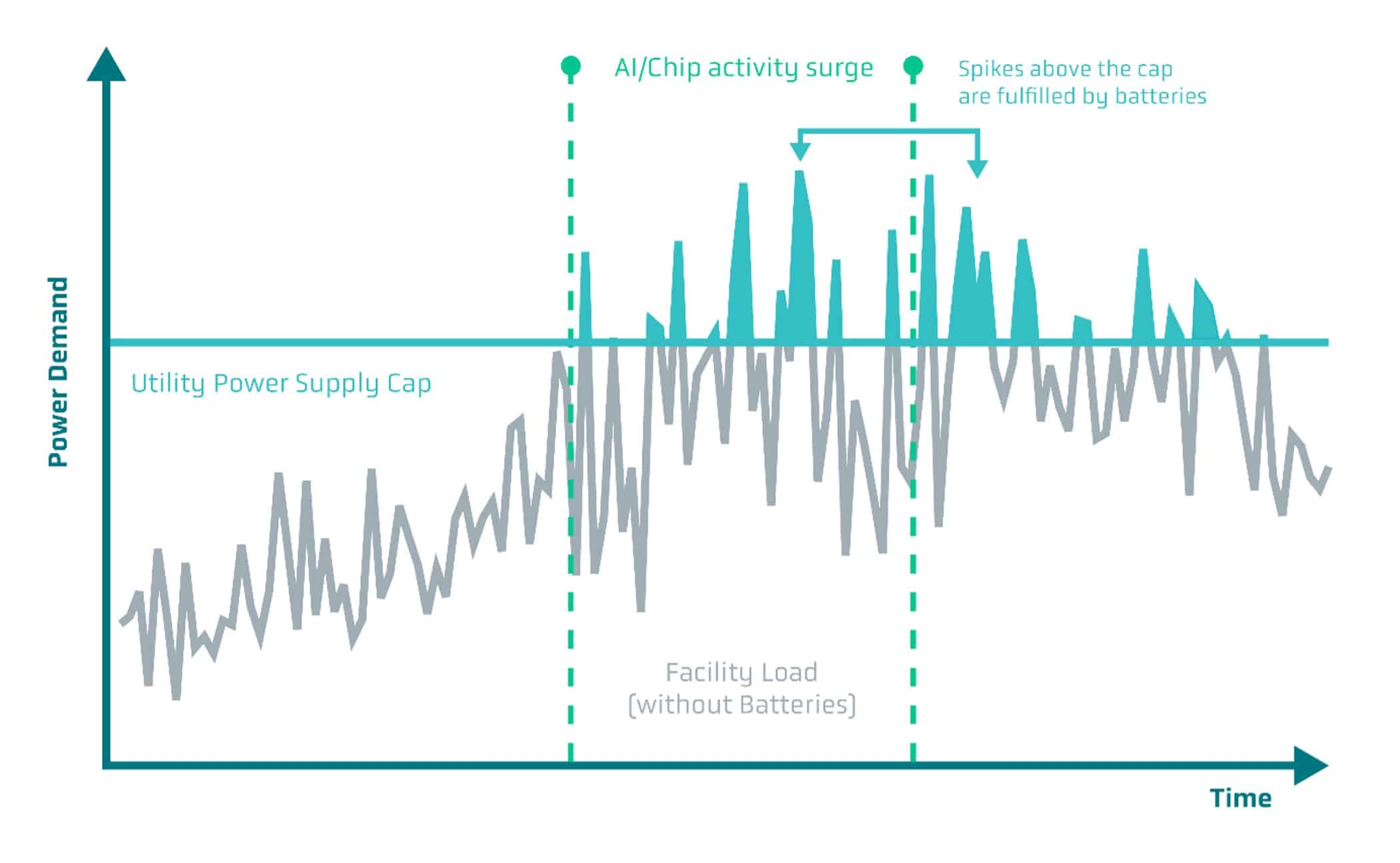
AI workloads are very different: especially training runs are far more variable and more unpredictable than traditional data storage and retrieval. AI workloads have huge spikes and dips in power demand that, if not managed properly, could destabilize entire power grids. In the worst case, mismanaging power in AI factories could plunge an entire city into a blackout. Some AI data centers actually have dummy workloads which do no useful computation but keep the chips running to prevent large drops in demand when the AI workload completes.
As AI power demands get higher, the problem of real-time power delivery becomes more and more acute, and no one can say for sure what AI workloads will look like in the future. To smooth out these large swings in power demand, batteries need to be capable of extremely high power performance to smooth out spikes and dips in AI workloads. QS technology enables batteries with both high energy density and high power simultaneously, to support demanding AI workloads while taking up less of the valuable space on the AI factory floor.
Conclusion
AI is one of the most consequential technologies of this century. But AI presents challenges in the physical world that need physical solutions. QS battery technology is a unique and compelling hardware solution to the physical challenges of building power-hungry AI factories. It can enable high-power AI workloads, safer system designs, and increased intelligence density to help power this once-in-a-century transformation.
AI racks are headed to 1 MW, and 48V power can’t keep up. Here’s why data centers are moving to 800V and how solid-state batteries fit the shift.
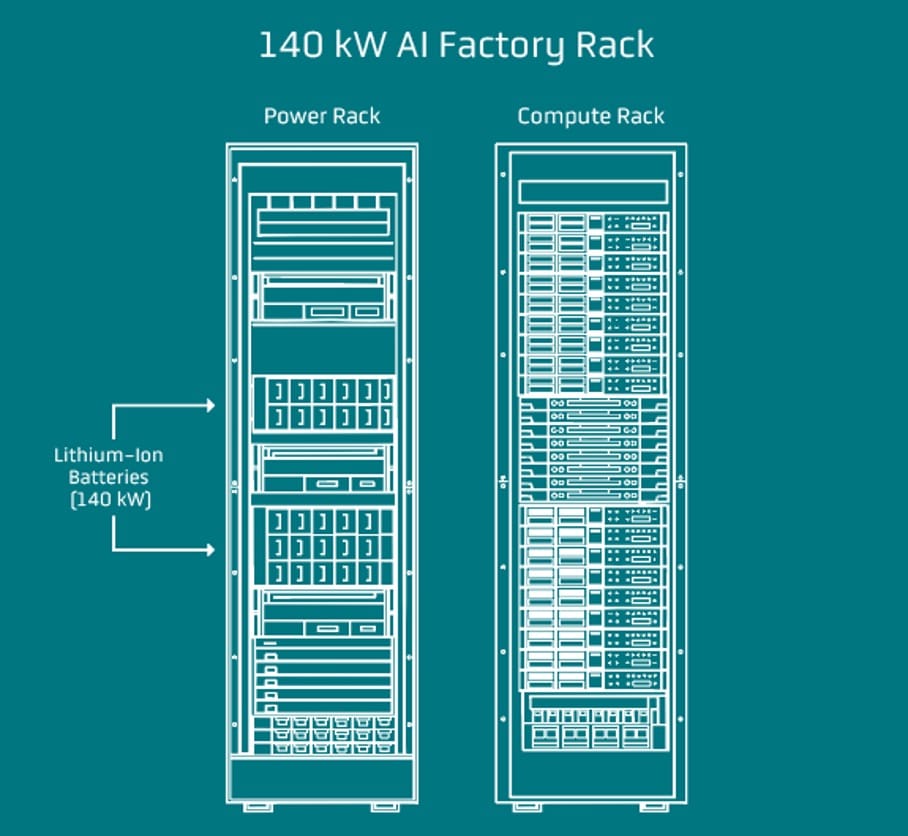
AI data centers are fundamentally different from the cloud data centers of the previous decade. Data centers of the past delivered data; modern AI data centers deliver intelligence.
AI racks are headed to 1 MW, and 48V power can’t keep up. Here’s why data centers are moving to 800V and how solid-state batteries fit the shift.
To adapt to the challenges of increasing power demand, AI factories need to reimagine how they get energy from power plants.