
Check out this article written by the experts on solid-state battery technology, QuantumScape, to learn about coulombic efficiency in electric vehicles.
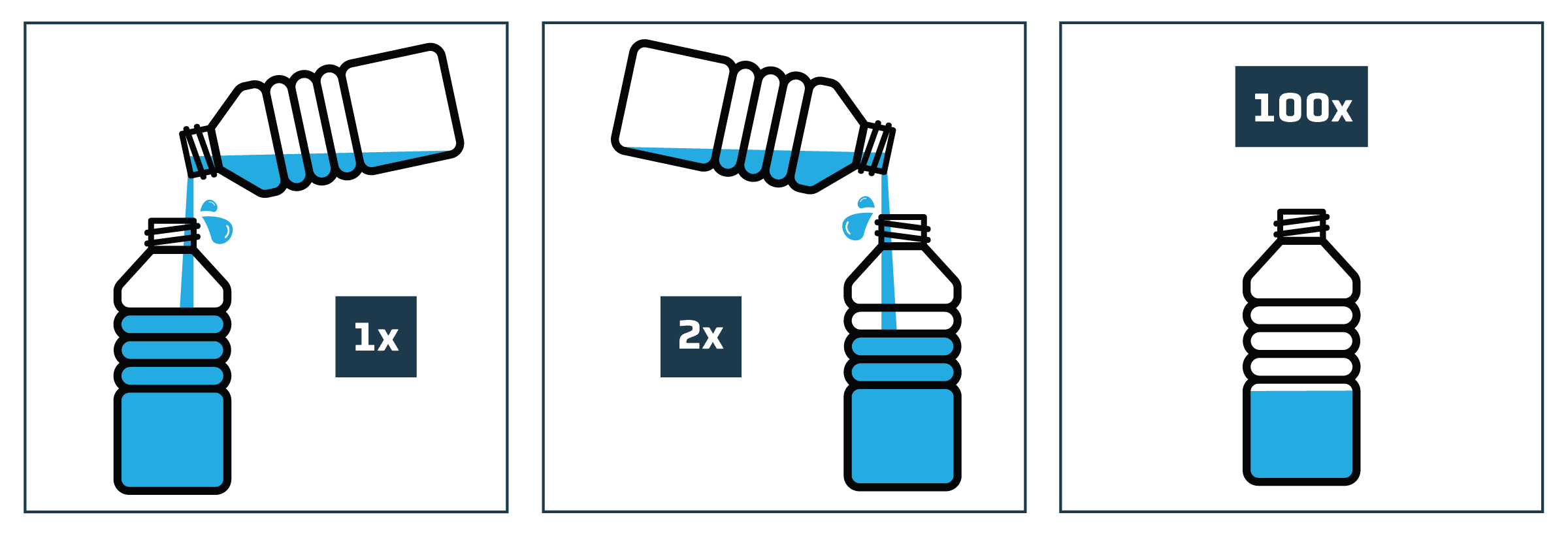
Let’s say you have a 1-liter bottle of water and you pour all of its contents into another empty 1-liter bottle and then back to the original bottle. A few drops of water spill as you do so. The loss is hardly noticeable — the drops may account for only 1% of the total, so you still have 99% of the water that you started with. This example essentially illustrates Coulombic efficiency — the ratio between the number of electrons (units of electrical charge) transferred from one electrode of a battery cell to the other during charge and the number transferred back during discharge. The difference between these two numbers typically reflects the fact that some lithium ions are lost during the charge/discharge process. The higher the Coulombic efficiency, the less capacity the battery loses in each charge/discharge cycle, and the longer its potential lifespan.
In our water bottle example, the equivalent Coulombic efficiency would be 99% — total (100%) minus percent lost (1%). 99% may sound like really good retention, but when you think about this happening many times in succession, the effect quickly adds up. For example, if you continue to pour the water back and forth between the two bottles 100 times, losing 1% of the water in each pour, you’ll end up with ~37% of the original volume, or 370 mL — and that loss will be very noticeable.
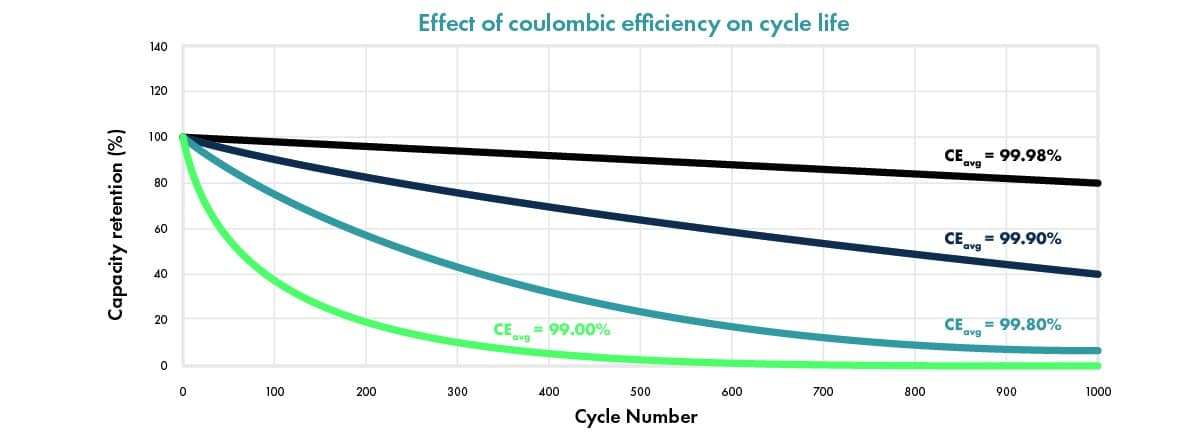
This is similar to what happens in batteries. Lithium ions in a battery are like the water in our analogy, with each bottle pour representing another battery charge/discharge cycle. As lithium ions move between the anode and cathode during charge and discharge, some are lost to side reactions. No physical system is ever perfectly efficient, and although 99% efficiency may sound excellent, the following chart demonstrates how the energy storage capability of a lithium-ion battery with a Coulombic efficiency of 99% decays dramatically after only a few dozen cycles.[1]
[1]www.nature.com/articles/s41560-020-0648-z?proof=t
One important caveat: to measure Coulombic efficiency accurately, the effects of any excess lithium must be excluded.[2] QuantumScape’s technology does not require extra lithium foil on the anode, but some other lithium-metal technologies do. A cell that contains extra lithium-metal foil on the anode may temporarily mask capacity fade in cells with low Coulombic efficiency, and Coulombic efficiency may even appear to exceed 100% during early cycles.[3] However, adding extra lithium foil does not solve the underlying problem, and carries penalties in the form of added materials cost and a more complex manufacturing process, which both make the cell more expensive.
Electric vehicle batteries must have excellent Coulombic efficiency, but that is not enough on its own. Battery cells can face a lot of challenges over a lifetime of hundreds of charge/discharge cycles, such as resistance growth or dendrite formation. A cell’s Coulombic efficiency represents the maximum limit of its cycle life performance, assuming these other problems don’t get in the way.
[2] For more information on excess lithium in lithium-metal batteries, see our blog on liquids and polymers with lithium metal.
[3] This is because the loss of lithium is compensated for by the extra lithium available in the foil. However, resistance growth due to side reactions will reduce the accessible capacity, reducing the battery's capability to store energy.
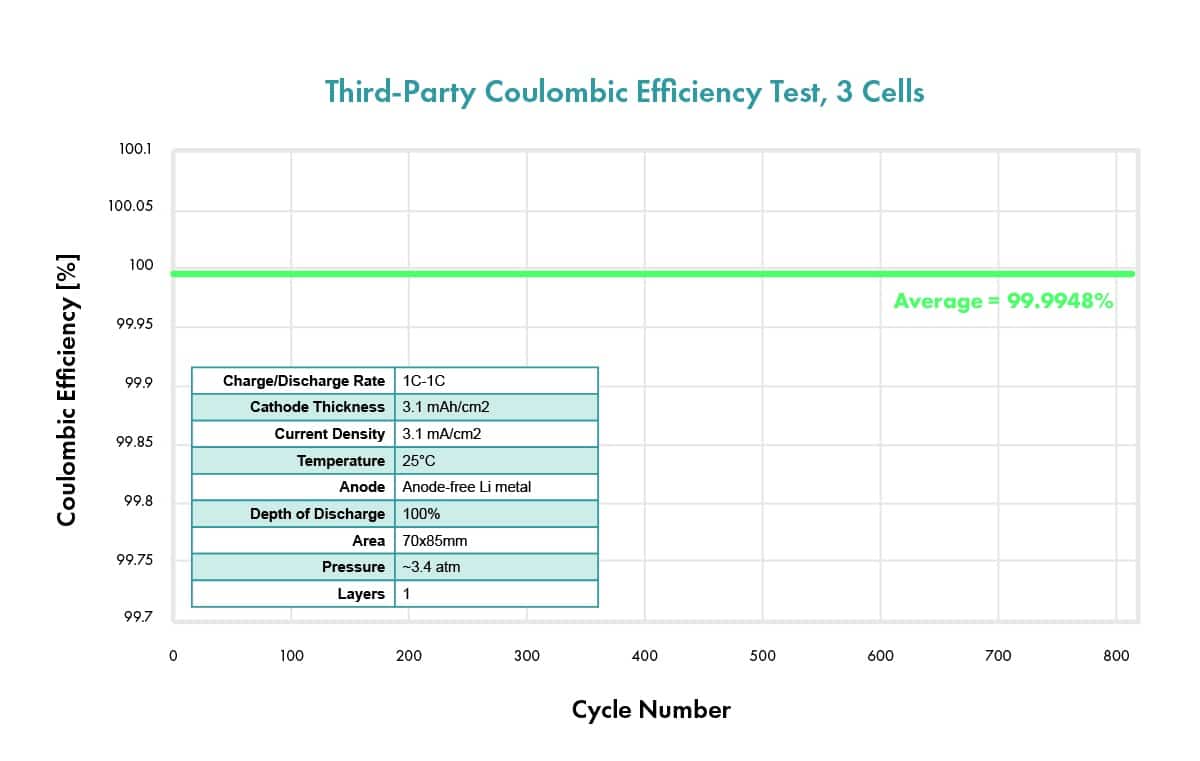
As the chart above shows, QuantumScape’s technology exhibits excellent Coulombic efficiency of better than 99.99% while also addressing dendrite formation and resistance growth. This has enabled our test cells to demonstrate cycle life better than 80% over 800 cycles with zero extra lithium. We believe any battery technology that aspires to replace legacy lithium-ion batteries in EVs must demonstrate the ability to meet all of these requirements simultaneously.
Forward-Looking Statements
This publication contains forward-looking statements within the meaning of the federal securities laws. All statements other than statements of historical fact contained in this publication, including statements regarding QuantumScape’s technology roadmap; the future development, performance, safety and anticipated benefits of its technologies, products and manufacturing processes; the results of testing and demonstrations, including in real-world applications; potential markets, applications and use cases; its strategy, business model, anticipated milestones, and plans for licensing, partnerships, collaborations and its ecosystem; the timing of commercialization and scale-up; and industry trends, estimates of addressable markets, and expected demand for batteries and the value thereof, are forward-looking statements. When used in this publication, the words “aim,” “allow,” “anticipate,” “believe,” “blueprint,” “can,” “committed,” “continue,” “could,” “designed to,” “enable,” “estimate,” “expect,” “focus,” “forecast,” “future,” “goal,” “going forward,” “intend,” “may,” “offers,” “opportunity,” “outlook,” “permit,” “plan,” “position,” “potential,” “predict,” “project,” “prospective,” “roadmap,” “seek,” “should,” “strategy,” “target,” “up to,” “will,” “work toward,” “would,” and the negative of such terms and other similar expressions are intended to identify forward-looking statements, although not all forward-looking statements contain such identifying words.
These forward-looking statements are based on management’s current expectations, assumptions, hopes, beliefs, intentions, and strategies regarding future events and are based on currently available information as to the outcome and timing of future events. They are not guarantees of future performance and involve significant risks and uncertainties that could cause the actual results to differ materially from the expected results, including risks related to technology development and scale-up, production, commercialization, partnerships and licensing, entry into new markets, costs and financing, trade and geopolitical conditions, competition, and intellectual property. Many of these factors are outside QuantumScape’s control and are difficult to predict. Performance demonstrated in sample cells or in internal, customer, or third-party testing may not be replicated at scale or in commercial products. QuantumScape cautions readers and viewers not to place undue reliance upon any forward-looking statements, which speak only as of the date made. Except as otherwise required by applicable law, QuantumScape disclaims any duty to update any forward-looking statements. Should underlying assumptions prove incorrect, actual results and projections could differ materially from those expressed in any forward-looking statements. Additional information concerning these and other factors that could materially affect QuantumScape’s actual results can be found in the “Risk Factors” section of QuantumScape’s most recent Annual Report on Form 10-K and subsequent Quarterly Reports on Form 10-Q, as well as its other filings with the SEC, which are available on the SEC’s website at www.sec.gov.